BRAKE CONTROL / DYNAMIC CONTROL SYSTEMS VEHICLE STABILITY CONTROL SYSTEM CALIBRATION
DESCRIPTION
After replacing any VSC related components or performing wheel alignment adjustment, clear and read the sensor calibration data.
Refer to the table below and then perform the necessary operation according to the part to be replaced in order to perform calibration.
| Parts to be Replaced / Operation | Necessary Operation |
|---|---|
| Skid control ECU (brake actuator assembly) | Yaw rate and acceleration sensor zero point calibration. |
| Yaw rate and acceleration sensor (airbag ECU assembly) | 1.
Clearing zero point calibration data. 2.
Yaw rate and acceleration sensor zero point calibration. 3.
Deceleration sensor zero point calibration and CVT oil pressure calibration. Click here( |
| Wheel alignment adjustment | 1.
Clearing zero point calibration data. 2.
Yaw rate and acceleration sensor zero point calibration. |

OBTAIN ZERO POINT OF YAW RATE AND ACCELERATION SENSOR (When Using GTS)
- NOTICE:
- ·
While obtaining the zero point, keep the vehicle stationary and do not vibrate, tilt, move, or shake it.
·Be sure to perform this procedure on a level surface (with an inclination of less than 0.25 degrees).
·While obtaining the zero point, make sure the tire pressure is as specified and the vehicle is in full contact with the ground (not lifted up or loaded).
Clear the zero point calibration data.
Turn the engine switch off.
Check that the steering wheel is centered.
Apply the parking brake.
Check that the shift lever is in neutral (for manual transaxle).
Check that the shift lever is in P (for continuously variable transaxle).
Connect the GTS to the DLC3.
Turn the engine switch on (IG).
Turn the GTS on.
Select the skid control ECU (brake actuator assembly) to clear the zero point calibration data using the GTS. Enter the following menus: Chassis / ABS/VSC/TRC / Utility / Reset Memory.
- Chassis > ABS/VSC/TRC > Utility
-
Tester Display Reset Memory - 50005 105 138
Turn the engine switch off.
- NOTICE:
-
If the engine switch is turned on (IG) for more than 15 seconds with the shift lever in P (for continuously variable transaxle) or the parking brake applied (for manual transaxle) after the zero point of the yaw rate and acceleration sensor has been cleared, only the zero point of the yaw rate sensor will be stored. If the vehicle is driven under these conditions, the skid control ECU (brake actuator assembly) will store the zero point calibration for the acceleration sensor as not being completed. The skid control ECU (brake actuator assembly) will then also indicate this as a malfunction of the VSC system using the indicator light.
Perform the zero point calibration of the yaw rate and acceleration sensor.
Turn the engine switch off.
Check that the steering wheel is centered.
Apply the parking brake.
Check that the shift lever is in neutral (for manual transaxle).
Check that the shift lever is in P (for continuously variable transaxle).
- NOTICE:
-
DTCs C1210 (Zero Point Calibration of Yaw Rate Sensor Undone) and C1336 (Zero Point Calibration of Acceleration Sensor Undone) will be stored if the shift lever is not in P (for continuously variable transaxle) or the parking brake is not applied (for manual transaxle).
Connect the GTS to the DLC3.
Turn the engine switch on (IG).
Turn the GTS on.
Switch the skid control ECU (brake actuator assembly) to Test Mode using the GTS. Enter the following menus: Chassis / ABS/VSC/TRC / Utility / Test Mode.
- Chassis > ABS/VSC/TRC > Utility
-
Tester Display Test Mode - 50005 105 166
After Test Mode has been entered, keep the vehicle stationary on a level surface for 5 seconds or more.
Check that the slip indicator light comes on for several seconds and then blinks in the Test Mode pattern.
- HINT:
- ·
If the slip indicator light does not blink, perform zero point calibration again.
·Zero point calibration is performed only once after the system enters Test Mode.
·Calibration cannot be performed again until the stored data is cleared.
Turn the engine switch off and disconnect the GTS.
OBTAIN ZERO POINT OF YAW RATE AND ACCELERATION SENSOR (When Using SST Check Wire)
- NOTICE:
- ·
While obtaining the zero point, keep the vehicle stationary and do not vibrate, tilt, move, or shake it.
·Be sure to perform this procedure on a level surface (with an inclination of less than 0.25 degrees).
·While obtaining the zero point, make sure the tire pressure is as specified and the vehicle is in full contact with the ground (not lifted up or loaded).
Clear the zero point calibration data.
Turn the engine switch off.
Check that the steering wheel is centered.
Apply the parking brake.
Check that the shift lever is in neutral (for manual transaxle).
Check that the shift lever is in P (for continuously variable transaxle).
Turn the engine switch on (IG).
The warning light and indicator light come on for 3 seconds to indicate that the initial check has completed.
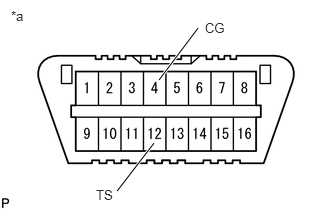
| *a | Front view of DLC3 |
Using SST, connect and disconnect terminals TS and CG of the DLC3 4 times or more within 8 seconds.
- SST
- 09843-18040
Check that the slip indicator light comes on.
- NOTICE:
-
If the engine switch is turned on (IG) for more than 15 seconds with the shift lever in P (for continuously variable transaxle) or the parking brake applied (for manual transaxle) after the zero point of the yaw rate and acceleration sensor has been cleared, only the zero point of the yaw rate sensor will be stored. If the vehicle is driven under these conditions, the skid control ECU (brake actuator assembly) will store the zero point calibration for the acceleration sensor as not being completed. The skid control ECU (brake actuator assembly) will then also indicate this as a malfunction of the VSC system using the indicator light.
Turn the engine switch off.
Perform the zero point calibration of the yaw rate and acceleration sensor.
Turn the engine switch off.
Check that the steering wheel is centered.
Apply the parking brake.
Check that the shift lever is in neutral (for manual transaxle).
Check that the shift lever is in P (for continuously variable transaxle).
- NOTICE:
-
DTCs 36 (Zero Point Calibration of Yaw Rate Sensor Undone) and 39 (Zero Point Calibration of Acceleration Sensor Undone) will be recorded if the shift lever is not in P (for continuously variable transaxle) or the parking brake is not applied (for manual transaxle).
| *a | Front view of DLC3 |
Using SST, connect terminals TS and CG of the DLC3.
- SST
- 09843-18040
Turn the engine switch on (IG).
After Test Mode has been entered, keep the vehicle stationary on a level surface for 5 seconds or more.
Check that the slip indicator light comes on for several seconds and then blinks in the Test Mode pattern.
- HINT:
- ·
If the slip indicator light does not blink, perform zero point calibration again.
·Zero point calibration is performed only once after the system enters Test Mode.
·Calibration cannot be performed again until the stored data is cleared.
Turn the engine switch off and disconnect SST from the DLC3.